Why Your Kitchen Faucet Pressure Is Suddenly Low
Kitchen faucet pressure suddenly low? Learn the most common causes, simple DIY checks you can try, and when it’s time to call a plumber to protect your fixtures.
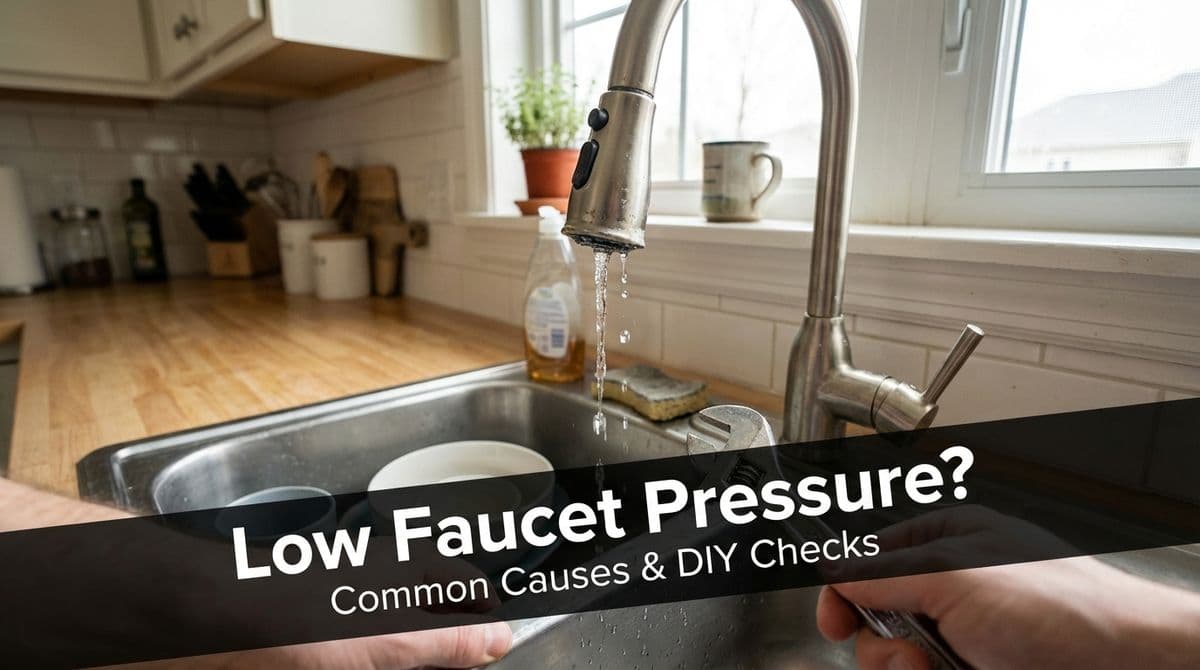
When Your Kitchen Faucet Suddenly Loses Pressure
We recently got a call from a customer — let’s call him Mark — who was frustrated with his kitchen sink. His faucet had been working fine for years, then almost overnight the water flow dropped to a trickle. Hot and cold were both weak, and he was worried it might also be affecting his dishwasher that ties into the same line.
Mark had already done what a lot of handy homeowners try first: he checked the faucet head and looked for a filter he could clean. Nothing obvious was clogged, but the water pressure was still terrible. That’s when he decided it was time to have a pro look at it.
Since this is something we get calls about all the time, I figured I’d walk through the most common reasons your kitchen faucet suddenly has low water pressure, what you can safely check yourself, and when it’s smarter (and safer) to call a plumber.
Common Causes of Sudden Low Pressure at a Kitchen Faucet
When a faucet goes from “normal” to “weak” in a short period of time, we usually start by looking at a few usual suspects.
1. Clogged Aerator or Faucet Head
The aerator is the small screen at the tip of your faucet where the water comes out. Over time, it can clog with:
- Mineral deposits (especially if you have hard water)
- Sand or grit from the water line
- Debris loosened during recent plumbing work or city line maintenance
This is the simplest and most common cause. In Mark’s case, he’d already removed the head and didn’t see an obvious blockage, but it’s still the first thing we always rule out.
2. Clogged Cartridge Inside the Faucet
Most modern kitchen faucets, especially single-handle models, use a cartridge that mixes hot and cold water. That cartridge has small passages inside it that can clog with the same kind of debris that hits your aerator. When that happens, you get low flow on both hot and cold — just like Mark was seeing.
If your faucet is 3–5 years old and suddenly loses pressure, a partially clogged or failing cartridge is high on the list of likely causes.
3. Shut-Off Valves Not Fully Open
Under your kitchen sink you should have two small shut-off valves — one for hot, one for cold. If someone recently:
- Installed a new dishwasher or disposal
- Worked on your sink or countertop
- Turned water off for a repair
— it’s possible a valve wasn’t reopened all the way, or the valve itself is failing internally and restricting flow.
4. Debris in the Supply Lines
Any time work is done on your plumbing — whether inside your home or out at the street — sediment can get stirred up and travel into your home. That grit can:
- Settle in the flexible supply lines to your faucet
- Collect at bends in the piping
- Get trapped in small filters or check valves built into the faucet
If the dishwasher or another fixture tees off the same line, it can be affected too, which is exactly what Mark was worried about.
5. Bigger Picture: Whole-House Pressure Problems
If only your kitchen faucet is affected, it’s usually a local issue at the sink. But if you’re noticing weak flow in showers, bathroom faucets, or outdoor spigots as well, you could be dealing with:
- A failing pressure-reducing valve (PRV)
- Old, corroded galvanized pipes
- A partially closed main shut-off valve
In Mark’s case, the upstairs shower also had weak output, which told us there might be more going on than just a dirty aerator at the sink.
Simple DIY Checks You Can Safely Try First
Before you schedule a service call, there are a few safe checks most homeowners can handle with basic tools.
Step 1: Clean the Aerator
- Unscrew the aerator or spray head from the end of the faucet. You may need a small wrench or pliers with a towel to protect the finish.
- Check for grit or mineral buildup. If you see debris, rinse it thoroughly.
- Soak in vinegar for 30–60 minutes to dissolve mineral deposits.
- Rinse well and reattach. Turn the faucet on and see if flow improves.
If that fixes it, you’ve just solved the most common issue for free.
Step 2: Test Flow With the Head Removed
This is a trick we use on service calls and you can try it too:
- With the aerator or pull-down spray head removed, turn the faucet on gently.
- If the water comes out strong from the bare faucet, the problem is in the aerator or spray head.
- If it’s still weak, the restriction is upstream — in the cartridge, supply lines, or shut-off valves.
Step 3: Check the Under-Sink Valves
- Look under the sink for the hot and cold shut-off valves.
- Make sure they are turned fully counterclockwise to the open position.
- If a valve is hard to turn, leaking, or feels “crunchy,” it may be failing and restricting flow.
If you’re uncomfortable turning these valves or see corrosion, it’s better to stop there and give us a call.
When It’s Time to Call a Plumber
For Mark, the basic checks didn’t restore good pressure. The faucet was only a few years old, the head looked clean, and both hot and cold were equally weak. On top of that, his upstairs shower had a weak output too. Those clues told us we were likely dealing with a cartridge problem at the faucet, possibly combined with a mixing issue in the shower valve, and maybe even some debris in the lines from previous work.
Here are some signs you should bring in a professional:
- You’ve cleaned or replaced the aerator and pressure is still low.
- Both hot and cold are weak, and other fixtures are starting to act up.
- You’re not comfortable disassembling a faucet to access the cartridge.
- Valves or fittings under the sink look corroded, wet, or rusty.
- Your dishwasher or other appliances on the same line aren’t filling properly.
On our visit with Mark, we inspected the faucet, checked the shut-offs, tested pressure at the lines, and pulled the cartridge. A combination of mineral buildup and debris from previous work was choking things off. Once we cleaned and, in this case, replaced the worn components, the faucet and dishwasher both worked like they should again. While we were there, we also diagnosed the weak upstairs shower and gave him options for replacing some older faucets he’d been thinking about tackling himself.
Protecting Your Kitchen Faucet (and Appliances) Long-Term
To help avoid surprise low pressure issues in the future, we often recommend:
- Cleaning aerators every few months, especially with hard water.
- Having your system checked after major plumbing work or city water line repairs.
- Considering water treatment like a softener or whole-home filter if you see frequent mineral buildup.
- Scheduling a plumbing inspection if multiple fixtures start losing pressure at once.
If your kitchen faucet suddenly slows to a crawl and you’re not sure why, you don’t have to live with it — or guess. Try the simple checks above, and if it’s still not right, we’re happy to come out, track down the cause, and make sure your faucet, dishwasher, and other fixtures are all getting the water flow they need.